
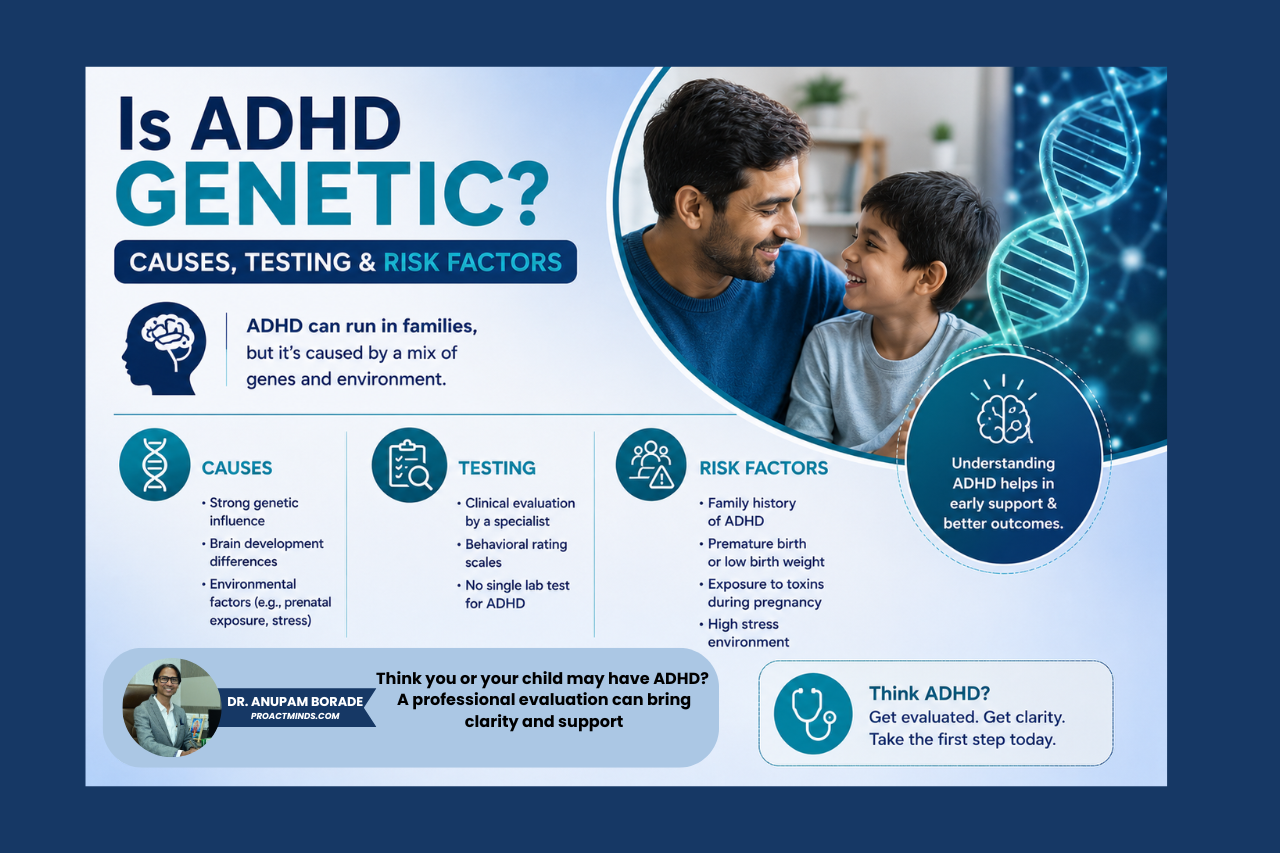
If ADHD seems to “run in the family,” you may have wondered whether there is more behind it than coincidence. Maybe a parent has ADHD, a sibling has similar traits, or you recognise patterns in yourself that have existed for years.
So, is ADHD genetic? Research strongly suggests that genetics play a major role in ADHD. However, ADHD is not caused by one single gene. It develops through a complex combination of genetic, developmental and environmental influences.
What Are the Genetic Causes of ADHD?
There is no single “ADHD gene” responsible for the condition. Instead, many genetic variations can influence how the brain develops and functions, particularly systems involved in attention, motivation and impulse control.
How Do Genetic Factors Contribute to ADHD?
Genes can influence brain development and the way certain brain chemicals and neural networks function. When several genetic factors come together, they may increase a person’s likelihood of developing ADHD.
This means genetics can create a predisposition rather than a guaranteed outcome. Having genetic risk does not necessarily mean someone will develop ADHD.
Does Genetic Factor Cause ADHD?
So, does genetic factor cause ADHD? Genetics are considered one of the strongest contributors, but they are not the whole explanation.
ADHD is a complex condition influenced by multiple genes along with developmental and environmental factors. Researchers continue to study how these influences interact rather than looking for one single cause.
Also Read: Can adhd be cured
What Other Factors May Be Linked to ADHD?
Genetics are important, but ADHD does not have a one-factor explanation. Several influences may contribute to how ADHD develops and presents in different people.
Genetic Factors
Genetic differences can influence brain development, attention regulation and impulse control. This is one reason ADHD often appears in multiple members of the same family.
However, having a family history does not make ADHD inevitable.
Developmental Factors
Certain factors affecting development before or around birth may also be associated with a higher likelihood of ADHD.
Premature birth, low birth weight and some pregnancy-related factors have been studied in relation to ADHD risk. These factors do not mean that ADHD will definitely develop.
Environmental and Other Influences
Environmental influences may also interact with genetic vulnerability. Factors such as early-life exposures and certain developmental experiences have been investigated by researchers.
It is important not to oversimplify ADHD as being caused by parenting, screen time or one particular environmental factor. The condition is much more complex than that.
Is ADHD Genetic Testing Available?
You may come across companies offering ADHD genetic testing and wonder whether a simple DNA test can confirm ADHD. Currently, things are not quite that straightforward.
Genetic research can tell us a lot about ADHD risk, but genetic testing is not currently a standard way to diagnose ADHD.
What Is ADHD Genetic Testing?
ADHD genetic testing involves analysing a person’s DNA to look for specific genetic variations.
Although researchers have identified many genetic factors associated with ADHD, there is no single genetic test that can reliably determine whether someone has ADHD.
Genetic testing may sometimes be used in specific medical circumstances, but it should not be treated as an ADHD diagnosis.
Can Genetic Testing Diagnose ADHD?
At present, genetic testing cannot diagnose ADHD on its own.
There is no single genetic marker that can say, “Yes, this person has ADHD.” ADHD diagnosis relies mainly on a detailed clinical assessment of symptoms, their duration, impact and developmental history.
A DNA report therefore cannot replace a proper ADHD assessment.
When Might Someone Consider Genetic Testing?
A healthcare professional may recommend genetic testing when there are broader medical or developmental concerns where understanding someone’s genetic background could be useful.
However, someone seeking an ADHD diagnosis generally does not need genetic testing as the first step.
If you suspect ADHD, a professional assessment is much more useful for understanding whether your symptoms fit the condition.
Can ADHD Run in Families?
Yes. ADHD commonly appears in families, which is one of the reasons researchers have strong evidence for its genetic component.
Having a relative with ADHD can increase the likelihood of developing the condition, but family history is not a guarantee.
Does Having a Parent With ADHD Increase the Risk?
Having a parent with ADHD can increase a child’s likelihood of developing ADHD because genetic factors can be inherited.
This does not mean the child will definitely have ADHD. Genes influence risk, but other developmental and environmental factors also play a role.
Can ADHD Be Passed From Parents to Children?
ADHD itself is not passed down in the same simple way as traits such as blood type.
Instead, children can inherit genetic variations that increase their susceptibility to ADHD. Multiple genes can contribute to this vulnerability, which is why the condition can look different even among family members.
What If There Is No Family History of ADHD?
Not having a known family history does not mean ADHD is impossible.
A family member may have never been formally diagnosed, particularly if they grew up when awareness of ADHD was lower. Genetic factors can also arise through combinations that are not obvious from looking at a family tree.
How Is ADHD Diagnosed?
If you are wondering whether your difficulties with attention, organisation, impulsivity or restlessness could be ADHD, the next step is not necessarily a genetic test.
ADHD is diagnosed through a comprehensive assessment rather than a blood test or DNA test.
What Does an ADHD Assessment Involve?
An ADHD assessment usually involves discussing symptoms, developmental history, daily functioning and how difficulties affect different areas of life.
A professional may also consider information about school, work, relationships and family history. Other possible explanations for similar symptoms may also need to be explored.
Why Genetic Testing Is Not the Same as ADHD Diagnosis
A genetic test looks at DNA. An ADHD assessment looks at the person.
Because ADHD involves a broad combination of symptoms and experiences, there is currently no genetic test that can confirm the diagnosis. A professional needs to understand how symptoms have developed and how significantly they affect everyday functioning.
When Should Someone Consider an ADHD Assessment?
Consider speaking with a professional if ongoing difficulties with attention, organisation, impulsivity, forgetfulness or restlessness are interfering with your studies, work, relationships or everyday responsibilities.
You do not need to have every commonly discussed ADHD trait to seek an assessment. The goal is to understand what is actually happening rather than trying to diagnose yourself from a checklist.
What Does Research Say About ADHD and Genetics?
Research has consistently pointed towards a strong genetic component in ADHD. At the same time, scientists are still working to understand exactly how different genes and other influences interact.
Current Understanding of ADHD Genetics
Current research suggests that ADHD is highly heritable, with many genetic variants contributing small amounts to overall risk.
This helps explain why ADHD can appear across generations while still looking different in each person. Genetics influence susceptibility, but they do not provide a simple prediction of who will develop ADHD.
What Researchers Are Still Studying
Researchers are continuing to investigate which genetic variations are involved and how they interact with brain development and environmental influences.
The goal is not simply to find an “ADHD gene,” but to understand the complex biological pathways involved in the condition.
Getting an ADHD Assessment
If you recognise yourself in descriptions of ADHD, you do not need to solve the genetics puzzle before asking for help.
A professional assessment can help you understand your symptoms, rule out other possibilities and identify appropriate support.
When Professional Evaluation May Help
Professional evaluation may be helpful when attention difficulties, impulsivity, forgetfulness, disorganisation or restlessness have become persistent and are affecting your daily life.
Rather than relying on online quizzes or genetic reports, an assessment gives you the opportunity to discuss your experiences in detail with a qualified professional.
What to Expect From an ADHD Assessment
An ADHD assessment involves a conversation about your symptoms, developmental history and everyday functioning. You may also be asked about your family history and experiences at school, work or home.
The process is designed to understand the bigger picture rather than focus on one isolated symptom.
ADHD Support at ProactMinds
At ProactMinds, mental health professional support can help individuals better understand attention-related difficulties and explore whether an ADHD assessment may be appropriate.
If ADHD is affecting your relationships, studies, work or daily routine, reaching out for an assessment can be a useful first step towards understanding your experiences and finding the right support.
Frequently Asked Questions
Yes, genetics play a significant role in ADHD. However, ADHD is not caused by one single gene. Multiple genetic factors can influence a person's likelihood of developing the condition, along with developmental and environmental influences.
There is no single genetic cause of ADHD. Instead, many genetic variations may contribute to differences in brain development and functions related to attention, motivation and impulse control.
Genetic factors are considered one of the strongest contributors to ADHD, but they do not act alone. ADHD develops through a complex interaction of genetic, developmental and environmental influences.
No. ADHD genetic testing cannot currently diagnose ADHD. There is no single genetic test that can confirm whether someone has ADHD. Diagnosis requires a comprehensive clinical assessment.
Not necessarily. Having a parent with ADHD can increase a child's genetic risk, but it does not guarantee that the child will develop the condition. Other genetic, developmental and environmental factors also influence ADHD.