Your workday technically ends at 6 PM. But your phone still lights up at 8:47 PM. A colleague needs a “quick” answer. Your manager sends a message. There is an email waiting. You tell yourself you will just check it once.
And suddenly, work has followed you to dinner, into your evening, and sometimes even into bed.
Being connected can make work easier, but being constantly available can quietly blur the line between professional responsibilities and personal life. Over time, this can affect sleep, relationships, concentration, and emotional wellbeing. This is where work life balance becomes more than a productivity trend. It becomes a mental health concern.
What Does Work Life Balance Actually Mean?
The work life balance meaning is not about dividing your day perfectly between work and personal life. Realistically, some weeks will be more work-heavy, while others may leave more room for yourself.
Work life balance is about having enough boundaries and flexibility to meet professional responsibilities without allowing work to consistently take over your personal life.
Why Being Always Available Can Feel Normal
For many people, being reachable has slowly become part of the job. Smartphones, instant messaging apps, and remote working tools mean there is always another notification waiting.
When everyone around you responds immediately, not responding can start to feel irresponsible. You may begin checking messages automatically, even when nobody has asked you to be online.
When Availability Becomes a Mental Load
Being available does not always mean actively working. Sometimes, simply knowing that a message could arrive is enough to keep your brain in work mode.
You may be watching a movie while thinking about tomorrow’s presentation or having dinner while wondering whether your manager will send another task. Your body may be at home, but your mind is still at work.
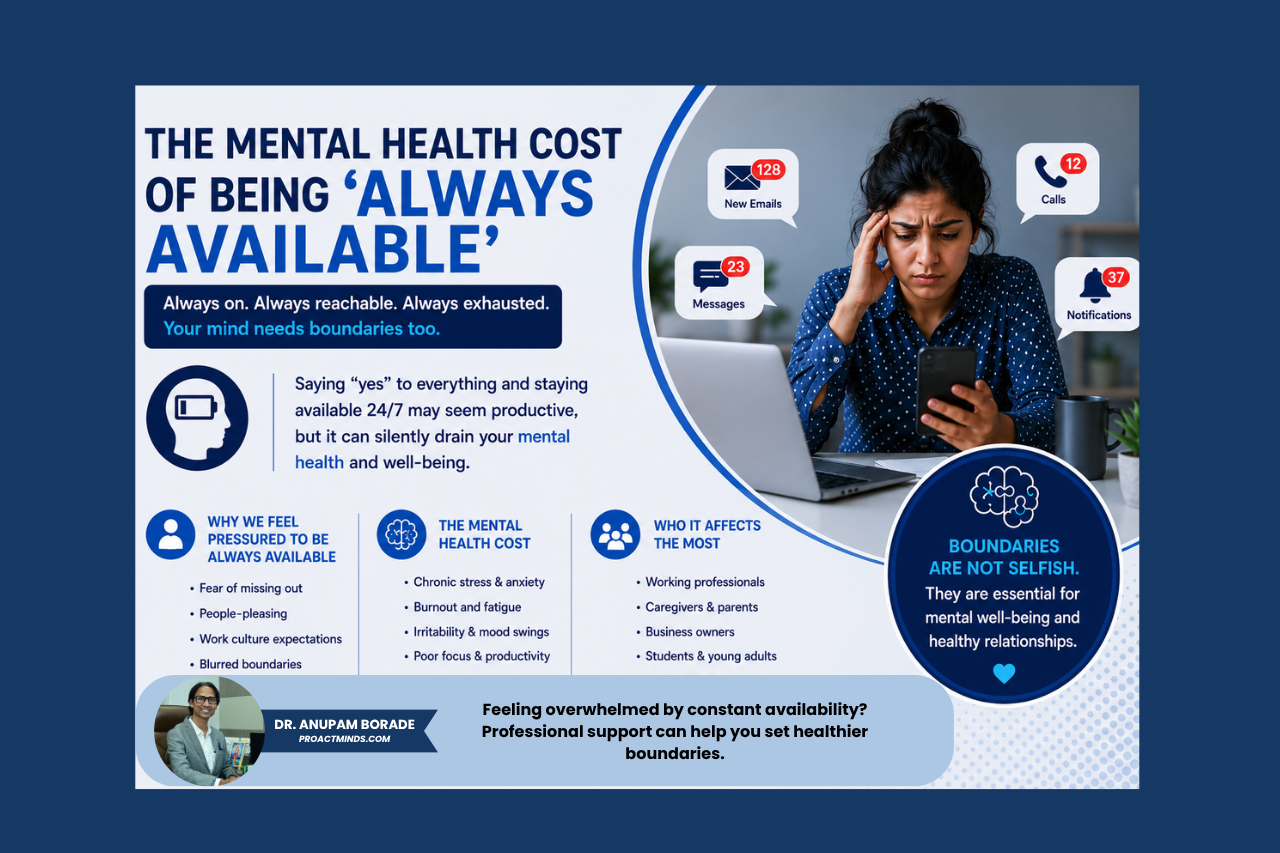
What Is the Mental Health Cost of Being Always Available?
Constant availability can create a state where your brain rarely gets a genuine break. Without enough recovery time, everyday responsibilities can begin feeling heavier than they normally would.
Over time, this can contribute to stress, emotional exhaustion, and difficulty switching off after work.
Stress Does Not Always Look Like a Breakdown
Stress is not always dramatic. Sometimes it looks like checking your phone every few minutes, feeling guilty when you are not working or becoming irritated by small things.
You may still be functioning, meeting deadlines and replying to messages. But internally, you may feel like you are running on low battery all the time.
Sleep Can Take the Hit
Late-night emails and work notifications can make it harder to mentally transition into rest.
Even when you put your phone away, your mind may continue replaying unfinished tasks or planning what needs to happen the next day. Poor sleep then makes it harder to concentrate and regulate emotions, creating another cycle of exhaustion.
Relationships Can Feel the Impact Too
When work repeatedly enters personal time, the people around you may start receiving whatever energy is left after the workday.
You might be physically present during dinner but mentally somewhere else. Over time, this can create distance in relationships and make personal time feel like another task squeezed between professional responsibilities.
Is Work Life Balance a Myth?
So, is work life balance a myth? If you imagine it as a perfect 50-50 split every single day, probably.
Life does not work that neatly. There will be deadlines, busy seasons, family responsibilities and unexpected situations. A healthier idea of work life balance is not perfect equality, but the ability to move between work and personal life without one permanently consuming the other.
Why Perfect Balance Is Not the Goal
Some days will belong more to work. Other days may need more attention at home or to your own wellbeing.
The goal is to have enough flexibility and boundaries that these shifts do not become a permanent pattern of sacrificing yourself for work.
Balance Looks Different for Everyone
A parent, freelancer, student, entrepreneur, and corporate employee may all have completely different definitions of balance.
For one person, it may mean switching off notifications after work. For another, it may mean having one evening a week without meetings. There is no universal formula.
What Does Work Life Balance Look Like in Real Life?
Sometimes, the easiest way to understand work life balance examples is to look at ordinary moments rather than imagine an unrealistic, perfectly organised lifestyle.
Balance can be found in small boundaries that protect your time and energy.
Work Life Balance Examples That Actually Feel Realistic
A few practical work life balance examples include not checking work emails during meals, taking a proper lunch break, keeping certain evenings meeting-free, and using your leave without feeling guilty.
It can also mean being able to say, “I will respond tomorrow,” when something is not genuinely urgent.
Balance Is Also About Mental Availability
You can technically leave the office on time and still be mentally stuck at work.
Real balance means creating opportunities where your attention is allowed to move elsewhere. Reading, exercising, spending time with friends, or simply doing nothing can all be valuable when they give your brain a chance to recover.
Why Young Professionals Often Struggle With Work Life Balance
For younger professionals, the pressure to prove yourself can make boundaries particularly difficult.
You may want to appear ambitious, dependable, and hardworking, especially early in your career. Saying yes to everything can feel like the safest way to build a reputation.
The Pressure to Prove You Are Committed
There can be an unspoken belief that the person who replies fastest is the person who cares most.
This can lead to staying online longer, accepting last-minute tasks, and feeling guilty about taking breaks. Eventually, being constantly available can become part of your identity rather than simply a work habit.
When Hustle Culture Starts Feeling Like a Requirement
Social media has made phrases like “rise and grind” and “sleep when you’re dead” sound motivational. But constantly operating at maximum capacity is not a sustainable lifestyle.
Productivity without recovery can eventually turn into exhaustion. Rest is not the opposite of ambition. It is part of being able to sustain it.
How to Manage Work Life Balance Without Feeling Guilty
Learning how to manage work life balance starts with recognising that boundaries are not a sign that you care less about your work.
They are a way of making your work sustainable while protecting the parts of life that exist outside your job.
Create a Clear End to Your Workday
A simple end-of-work routine can help your brain recognise that work is finished.
Closing your laptop, changing clothes, going for a short walk or deliberately moving to another activity can create a psychological transition between professional and personal time.
Stop Treating Every Notification as an Emergency
Not every message needs an immediate response.
Before opening a notification, ask yourself whether it is genuinely urgent or simply visible. Turning off non-essential work notifications outside working hours can also reduce the temptation to constantly check your phone.
Learn to Communicate Your Boundaries
Boundaries work better when they are communicated clearly.
Let colleagues know when you are available and when you will respond. You do not have to provide a long explanation every time you protect your personal time.
Make Time for Things That Have Nothing to Do With Work
A balanced life needs activities that do not produce a professional outcome.
Meet a friend. Read something unrelated to your industry. Go for a walk. Watch something silly. Sit with your family. Do absolutely nothing for a while. Your entire life does not need to be optimised.
What Does Work Life Balance in India Look Like?
The conversation around work life balance in India is increasingly important as work cultures evolve, especially with remote and hybrid working.
Long commutes, extended working hours, competitive workplaces, and the expectation of being reachable can make it difficult for employees to create a clear boundary between professional and personal time.
Why Work Boundaries Can Be Difficult to Maintain
In some workplaces, staying late or responding quickly may be seen as commitment rather than simply availability.
Employees may also hesitate to disconnect because they worry about appearing less dedicated than their colleagues. This can make healthy boundaries feel risky, even when they are necessary.
Building a Healthier Work Culture
Work life balance cannot always be solved by an individual. Employers also have a role in creating realistic workloads, respecting personal time, and avoiding unnecessary after-hours communication.
A healthy workplace should allow employees to be committed to their work without expecting them to be permanently connected.
When Does Work Stress Become a Mental Health Concern?
A busy week is not necessarily a mental health problem. The concern arises when stress becomes persistent and starts affecting how you function outside work.
If you constantly feel exhausted, anxious, irritable, or unable to switch off, it may be worth paying attention to what your mind and body are telling you.
Signs You May Need to Slow Down
Feeling tired even after resting, struggling to concentrate, becoming easily irritated or losing interest in activities you normally enjoy can all be signs that you are carrying too much stress.
You may also notice that work is affecting your sleep, relationships or ability to enjoy your personal time.
When Professional Support Can Help
If work-related stress feels overwhelming or continues despite making lifestyle changes, speaking with a mental health professional can help.
You do not have to wait until you experience complete burnout before asking for support. Sometimes, getting help early can make it easier to understand your stress and develop healthier coping strategies.
How ProactMinds Can Help
Finding better work life balance is not simply about becoming better at time management. Sometimes, the bigger challenge is understanding why switching off feels so difficult in the first place.
Professional support can help you explore stress, anxiety, emotional exhaustion, and patterns that may be affecting your ability to disconnect.
Support for Work-Related Stress
At ProactMinds, professional mental health support can help individuals navigate work-related stress and emotional challenges.
Counselling can provide a space to talk about workplace pressure, boundaries, burnout, and the expectations you place on yourself.
When to Consider Professional Support
If work stress is consistently affecting your sleep, mood, relationships or everyday functioning, it may be time to seek support.
You do not need to have a formal mental health condition to benefit from counselling. Sometimes, having a space to understand what you are experiencing can be the first step towards changing it.
Conclusion
The biggest problem with being “always available” is that eventually, you may forget what being unavailable feels like.
Your work deserves your attention, but it does not need every piece of it. A healthy work life balance allows you to work with focus, rest without guilt, and spend time being a person rather than constantly being an employee.
So, is work life balance a myth? Perfect balance probably is. But having boundaries, protecting your personal time, and knowing when to step away are very real and very important.
You do not need to disappear from work to protect your mental health. Sometimes, you simply need to stop letting work follow you everywhere.
Frequently Asked Questions
The work life balance meaning refers to maintaining a healthy relationship between professional responsibilities and personal life. It does not mean dividing your time equally, but having enough boundaries and flexibility to work without consistently sacrificing your wellbeing.
Is work life balance a myth? It can feel like one if you expect a perfect 50-50 division every day. In reality, balance changes depending on your responsibilities, but healthy boundaries can help prevent work from constantly taking over your personal life.
Learning how to manage work life balance can involve setting clear working hours, switching off unnecessary notifications, taking breaks, communicating boundaries, and making time for activities outside work. The goal is to create a sustainable routine rather than a perfect schedule.
Some work life balance examples include leaving work at a reasonable time, avoiding unnecessary after-hours messages, taking regular breaks, using your leave, spending uninterrupted time with loved ones, and making space for hobbies or rest.
Work life balance in India can vary significantly depending on the industry, workplace, and individual responsibilities. Long working hours, commuting, competitive work environments, and after-hours communication can make boundaries difficult, making healthy workplace practices particularly important.