
How often do you find yourself sitting in one place while your mind is somewhere else entirely? You may be eating while thinking about work, travelling while replaying an old conversation, or trying to sleep while tomorrow’s to-do list keeps running through your head.
The body is here. The mind, however, has already moved on.
Mindfulness is about changing that for a moment.
It is the simple practice of paying attention to what is happening right now, without rushing to judge it or push it away. Your breathing, the sounds around you, the sensations you feel, and even the emotions passing through your mind can all become part of that awareness.
What Is Mindfulness?
Imagine pressing pause on the mental noise for a few moments.
That is the basic idea behind mindfulness. It means bringing your attention to what you are experiencing in the present instead of constantly getting pulled into yesterday or tomorrow.
A mindfulness practice may begin with something as simple as breathing. You notice the rhythm of your breath, the air moving in and out, the sounds around you, and the sensations in your body. Slowly, your attention begins to settle. The interesting part is that mindfulness is not about forcing yourself to have an empty mind.
Thoughts can still appear. The difference is that you become more aware of them instead of automatically following every thought that comes along. Your senses also become an important part of the experience. You may notice a sound you had been ignoring, the feeling of your feet touching the ground, the movement of air around you, or an emotion that you had not stopped to acknowledge.
In a world where attention is constantly being pulled in different directions, simply noticing what is happening right now can be a meaningful practice.
What Is Mindfulness Day?
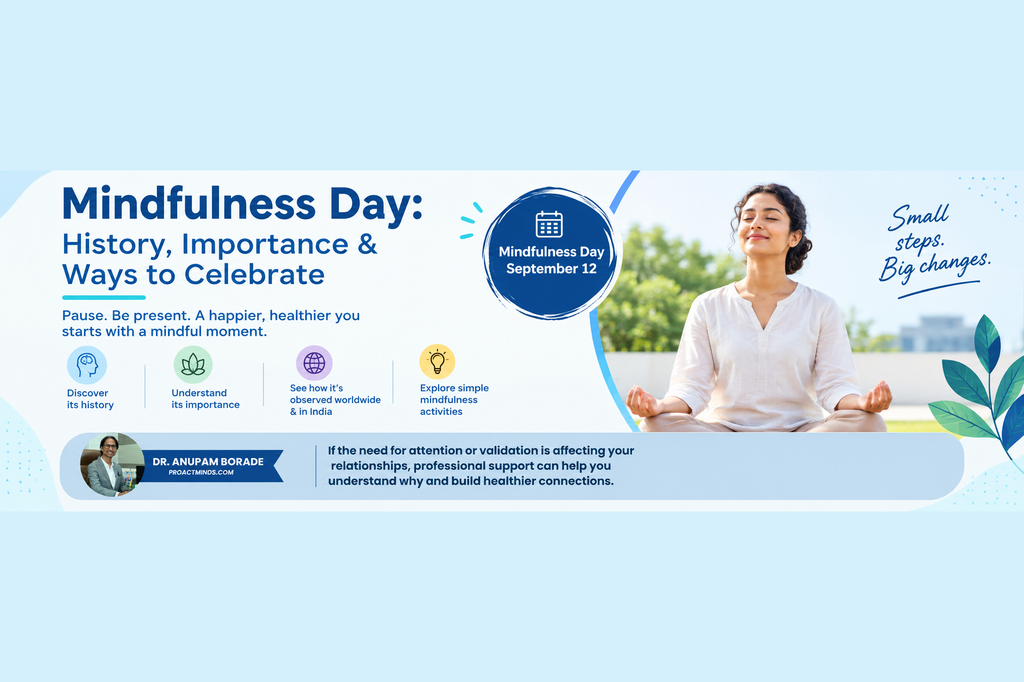
Mindfulness Day is observed on September 12 as a reminder to slow down, stay present, and pay attention to everyday experiences.
Founded by Wisdom Publications, the day encourages people to pause, notice their surroundings and make time for mindfulness and mental wellbeing.
Mindfulness does not require a long meditation session.
It can begin with a few quiet minutes of breathing, listening or simply noticing how you feel.
The History of Mindfulness Day
The history of Mindfulness Day can be traced to Wisdom Publications, which founded the observance in 2011. The intention was to create a dedicated occasion that encouraged people to pause, reflect, and reconnect with the present.
While the day itself is relatively recent, the practice of mindfulness has much older roots.
Mindful awareness has long been associated with contemplative traditions, particularly Buddhist practices. Over time, mindfulness also became part of modern wellbeing and therapeutic approaches, with practices centred around attention, breathing, body awareness and observing thoughts.
Today, mindfulness can be found in many different settings, including schools, workplaces, healthcare environments, community programmes and personal routines. This wider interest has also made mindfulness easier to approach. You do not necessarily need a particular setting or elaborate routine to begin noticing the present moment.
Why Is Mindfulness Day Celebrated?
We spend a surprising amount of time mentally somewhere else.
While having plans, remembering things, and thinking ahead are all part of everyday life, constantly moving between thoughts can make it difficult to notice what is actually happening around us. That is why the importance of Mindfulness Day lies less in the celebration itself and more in the pause it creates.
The day gives people a chance to ask a simple question: Am I actually present right now? It can encourage individuals, schools, workplaces and communities to explore mindfulness activities, create moments of reflection and talk more openly about everyday mental wellbeing.
Even a short pause can change the way we experience a moment. Instead of automatically reacting to everything around us, we can notice it first.
Why Is Mindfulness Important?
There is a difference between experiencing a moment and simply passing through it.
You could be having coffee with someone you care about while thinking about an email. You could be walking through a familiar street without noticing anything around you. You could be listening to someone while already preparing your response in your head.
Mindfulness brings your attention back. One of the key benefits of mindfulness is developing greater awareness of your thoughts, feelings, surroundings and physical sensations. It can also encourage a calmer, more deliberate approach to everyday experiences.
Breathing exercises are often used as a starting point because the breath gives you something concrete to pay attention to. As you focus on it, you may begin noticing other things too: the sounds in the room, the feeling of your body, your surroundings and the emotions you are experiencing.
Mindfulness is not about switching off every thought. It is about creating a little more space between having a thought and immediately getting carried away by it. That space can be valuable.
How Is Mindfulness Day Celebrated Around the World?
There is no single way to observe Mindfulness Day. People and organisations may mark the occasion through meditation sessions, breathing exercises, mindful walks, discussions, reflection exercises, yoga, workshops or other activities that encourage people to slow down and pay attention.
Some may choose a structured group activity, while others may simply spend a few quiet minutes away from their usual distractions.
Mindfulness activities can also be adapted for different age groups.
Children may explore awareness through games that encourage them to listen, observe, or notice their surroundings. Adults may prefer guided breathing, meditation, or mindful movement. The common thread is not the activity itself. It is the attention behind it. The goal is to spend some time noticing rather than rushing, listening rather than reacting, and experiencing the moment rather than letting it pass unnoticed.
How Is Mindfulness Day Observed in India?
Mindfulness has a natural connection with practices that many people in India are already familiar with. Meditation, yoga, breathing exercises, reflection and mindful movement are all ways individuals may explore greater awareness in their everyday lives.
However, these should not be seen as official Mindfulness Day activities in India. They are simply some of the practices people may choose to engage with. For some, mindfulness may begin with a few minutes of conscious breathing.
For others, it could mean taking a quiet walk without constantly checking their phone, eating without distractions, or spending time noticing their thoughts and emotions. The Indian context also makes mindfulness accessible in a very practical way.
It does not always have to involve creating a completely separate routine. Small moments of awareness can become part of an ordinary day. And sometimes, that is where the practice becomes most meaningful.
Mindfulness Day at ProactMinds
At ProactMinds, mindfulness is not simply something to read about once a year.
It is a practice that is experienced. The focus is on bringing people back to the present moment through breathing, awareness, and attention to what is happening around them. As participants become quieter and more attentive, their senses become more noticeable.
Sounds stand out. Physical sensations become easier to recognise. Feelings can be observed rather than immediately pushed aside. With Dr. Rajendra Barve guiding the mindfulness practice at ProactMinds, the experience becomes an opportunity to pause the constant stream of thoughts and reconnect with what is happening right now.
Because sometimes the mind does not need another answer. It simply needs a moment to stop running.
Looking Back at Last Year’s Mindfulness Activities
Last year, ProactMinds brought mindfulness into the open through a Mindfulness Walk, turning something as ordinary as walking into an opportunity to slow down and pay attention. A walk can easily become automatic.
We think about where we are going, what we have to do next, or what happened earlier in the day. A mindful walk changes the focus.
The attention comes back to the movement, the surroundings, the sounds and the experience of being there. The activity also created an opportunity for people to experience mindfulness together rather than treating it as something that only happens in isolation. This year, the Mindfulness Walk will return as part of the celebration, along with activities designed to make awareness more approachable and engaging for different age groups.
Join ProactMinds This Mindfulness Day
Mindfulness Day falls on September 12, but ProactMinds will bring the celebration to life on September 29 with an event centred around awareness, participation, and connection.
The celebration will include interactive games and activities for children, along with mindfulness coaching, awareness, and guided mindfulness practices with Dr. Rajendra Barve. The Mindfulness Walk will also return, carrying forward an activity that was part of last year’s celebration.
The event will bring together people from different walks of life, including students and representatives from colleges, commissions and educational institutions. It creates a space where mindfulness can be experienced, discussed and shared. The idea is not to make mindfulness complicated. It is to experience it.
To take a breath and actually notice it. To listen to the sounds around you instead of letting them fade into the background. To notice how you feel without immediately trying to change the feeling.
And for a few moments, to let the mind stop travelling everywhere else and simply be here.
This Mindfulness Day, take that pause. Notice the moment you are in.
You might be surprised by how much you usually miss.